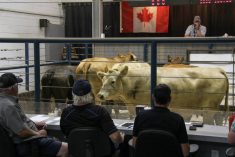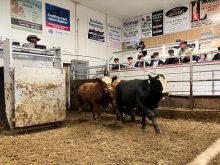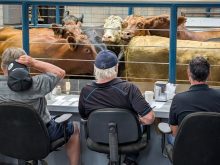
Drought has been the major story for Manitoba cattle producers this summer, but the effects have varied depending on the region.
While the Interlake and parts of eastern Manitoba have been hit the hardest by the hot and dry conditions, southwestern Manitoba has received much more precipitation, creating a less desperate situation for cattle sales.
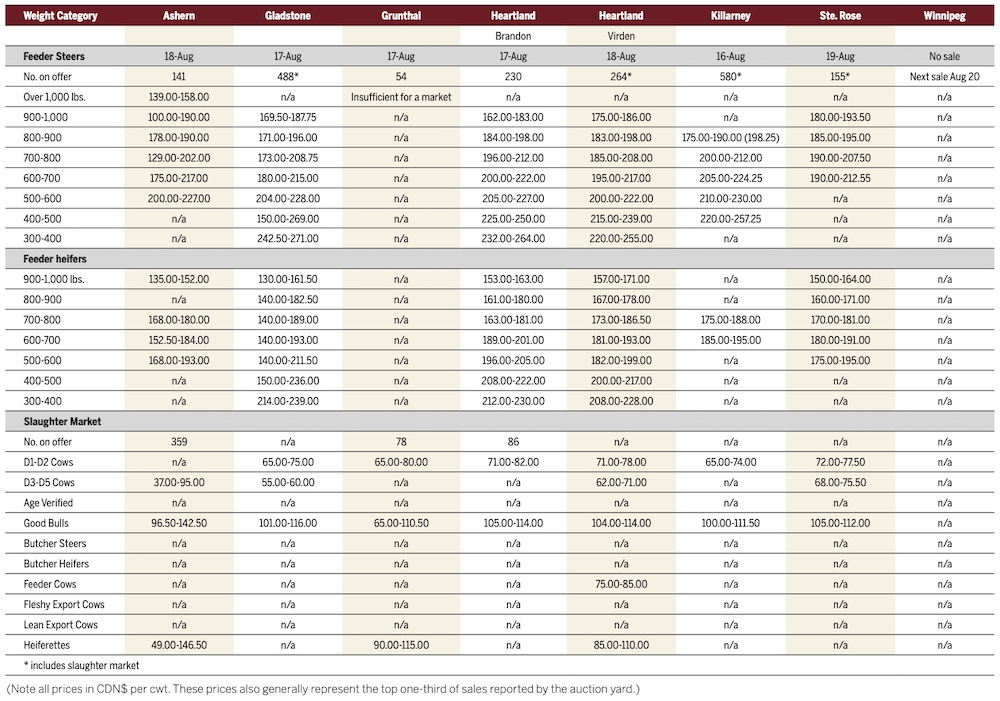
“(We’ve had) a little lighter run than what we have been seeing down here in the southwest corner of Manitoba,” said Colton McIntosh, marketing representative for Heartland Livestock Sales (HLS) at Virden. “We’ve experienced a little bit more rain than some other parts of Manitoba, which has definitely reduced the amount of cattle coming here over the last two or three weeks.”
Read Also
MBFI livestock research farm gets major expansion
Manitoba Beef & Forage Initiatives expands Brookdale Research Farm by 467 acres to benchmark grazing profitability at commercial scale.
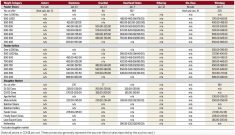
At HLS Virden’s sale on Aug. 18, 264 feeders and butchers went through the rings compared to the 1,059 that were sold on Aug. 11. Increased rainfall across Manitoba during the week ended Aug. 19 coincided with 2,435 head sold at seven auction sites, a 38 per cent decline from the 3,926 at five sites the previous week.
McIntosh mentioned there was some pressure on prices due to an influx of cattle from the Interlake entering the market, but except for a slight decline in the cost of butchers, prices were left largely unchanged across the province.
“Yearling cattle are still selling strong, maybe even to a bit of a higher market,” he said. “The gap between heifer calves and steer calves, price-wise, has definitely tightened up. However, they’ve definitely sold at a bit of a softer market this week.”
On the Chicago Mercantile Exchange (CME) on Aug. 19, the October live cattle contract closed at US$128.15 per hundredweight and has been trading sideways since mid-June. The September feeder cattle contract closed at US$162.90/cwt and has remained mostly steady since late July. The Canadian dollar significantly dropped during the week, losing 1.6 U.S. cents to close at 78.17 U.S. cents on Aug. 19.
With the falling loonie increasing prices, there seems to be more good news for local producers, according to McIntosh.
“Silage crops coming off or are about to come off are looking promising, which are definitely going to help some of the guys with winter seed for keeping their cow-calf operation going in this corner of Manitoba,” he said. “Pastures are holding out a little more than maybe guys anticipated with these late rains we’ve been seeing.
“As of right now, we’ve got a few farmers whose calves are coming to town a little earlier than they usually do, but for the most part, guys out here are going to be able to hold their calves and market them when they usually market them.”
In a statement released Aug. 16, Manitoba Beef Producers president Tyler Fulton thanked the federal government for increasing its share of AgriRecovery funding up to $500 million for producers affected by drought and wildfires.
“The more swiftly the programs under AgriRecovery can be initiated and monies flowed, the better able farmers and ranchers in Manitoba and other drought-affected provinces will be able to plan for their individual operations.”